Creative illustration showing a team building a mobile app with the headline “MVP Development for Startups – From Idea to Launch (2026 Guide)” by Oriental Outsourcing.

MVP Development for Startups: From Idea to Launch (2026 Guide)

 You have a great idea. Maybe it solves a real problem you have lived yourself. Maybe you have watched competitors leave money on the table and you know exactly how to fix it.

But then reality hits. Building software is expensive. Hiring developers is even more expensive. And if you build the wrong thing, you have wasted months and hundreds of thousands of dollars chasing a product nobody actually wants.

This is exactly why MVP development for startups has become the standard playbook for smart founders in 2026. Instead of building everything, you build just enough to test, learn, and grow.

This guide walks you through the entire MVP development process, from validating your idea to launching your first version, including what it costs, what mistakes to avoid, and how to get it built even if you do not have a technical co-founder.

What Is MVP Development for Startups?
Illustration of a team working on software development with a rocket launching from a screen and text reading “What Is MVP Development for Startups?

An MVP, or Minimum Viable Product, is the simplest version of your product that delivers core value to your target users. It is not a half-baked product. It is a focused one.

The goal of MVP development is not to build something perfect. It is to build something real, put it in front of users as quickly as possible, and use that feedback to decide what to build next.

Think of it this way: Airbnb started by letting strangers sleep on air mattresses in their apartment. Dropbox launched with a demo video before writing a single line of code. Uber tested in one city with a handful of drivers. None of them built the full product first.

That is the MVP mindset.

Why MVP Development Matters More in 2026

The startup landscape has changed dramatically. Here is what founders are dealing with right now:

AI-powered competition is moving faster. Thanks to AI coding tools and no-code platforms, your competitors can ship faster than ever. If you spend 18 months building version one, someone else has already captured your market. 

Investors expect proof before funding. Gone are the days when a pitch deck was enough. Most seed and Series A investors want to see real user traction before writing a check. An MVP gives you that. 

User expectations are higher but patience is lower. Users will try your product for 30 seconds before deciding if it is worth their time. An MVP forces you to nail the core experience before layering in complexity. 

Capital is more expensive. With tighter funding markets, every dollar counts. Spending $500K on a full product build before you have validated demand is a recipe for disaster.

In short, launching an MVP in 2026 is not just smart. It is survival.

The MVP Development Process: Step by Step

Here is the process successful founders follow when building and launching an MVP.

Step 1: Validate the Problem, Not the Solution

First, speak with at least 20 potential users before writing code. Instead of pitching, focus on understanding their frustrations. As a result, you can confirm the problem is real and worth solving.

Step 2: Define Your Core Value Proposition

Next, identify the single outcome your product delivers. In other words, clarify how it improves a user’s workflow. If this is unclear, then refine your thinking before building.

Step 3: Map the User Journey

Then, outline the simplest path from signup to first value. Additionally, remove any features outside this flow. This way, your MVP stays focused and practical.

Step 4: Choose the Right Tech Stack

Meanwhile, select a simple and flexible tech stack. For example, prioritize tools that allow fast iteration. Ultimately, speed matters more than scalability early on.

Step 5: Build in Sprints

After that, work in short cycles with clear deliverables. Furthermore, ensure each sprint produces something testable. Consequently, you maintain momentum and reduce risk.

Step 6: Soft Launch and Gather Feedback

Once ready, release to a small group of early users. Meanwhile, observe their behavior closely. Most importantly, identify friction and unexpected usage patterns.

Step 7: Iterate Using Real Data

Finally, prioritize improvements based on real feedback. Therefore, focus on retention and core experience before scaling.

Key Skills Required to Build a Successful MVP

Building a quality MVP requires a mix of technical and strategic expertise. Here is what needs to be covered on any MVP development team: 

  •       Product strategy and roadmap planning
  •       UI/UX design and user research
  •       Frontend development (web or mobile)
  •       Backend development and API architecture
  •       Database design and management
  •       Cloud infrastructure and DevOps
  •       QA testing and bug triage
  •       Analytics setup to track user behavior 

For most non-technical founders, assembling this team in-house is not realistic on a startup budget. A good agency covers all of this under one roof, from strategy and web and mobile development through to QA and launch. You pay for what you need, without salaries or equity.

MVP Development Cost for US Startups

One of the most common questions founders ask is: how much does it cost to build an MVP? The answer depends on complexity, the team you use, and the market they are in. Here is a realistic breakdown:

Team Type

Typical Cost Range

Timeline

US In-House Team

$150,000 – $400,000+

6–12 months

US Freelancers

$50,000 – $150,000

4–8 months

Offshore Dev Agency

$15,000 – $60,000

2–5 months

No-Code Tools (simple MVP)

$1,000 – $10,000

2–6 weeks

For most SaaS or mobile MVPs, a realistic MVP cost for startups working with an experienced offshore development agency falls between $20,000 and $50,000. That is a fraction of what you would spend hiring a US-based team, with comparable quality when you choose the right partner.

MVP vs. Full Product: What Is the Difference?

A lot of founders confuse MVP with beta or prototype. Here is how to think about each stage clearly:

Factor

MVP

Full Product

Goal

Validate assumptions fast

Deliver complete user experience

Features

Core value only

Full feature set

Timeline

8–16 weeks

6–18+ months

Cost

$15K – $60K

$100K – $500K+

Risk

Low

High

User base

Early adopters

Mass market

Iteration speed

Very fast

Slower


Common MVP Mistakes Founders Must Avoid

These mistakes show up again and again. Avoid them and you will be miles ahead of the competition.

Building features instead of solving a problem. Founders get excited and want to add everything. Resist. A focused MVP almost always outperforms a bloated one.

Skipping user research. If you have not talked to real users before writing code, you are guessing. Guesses are expensive.

Hiring the wrong development team. Cheap is not always good, and expensive does not mean quality. Look for a partner with proven MVP experience, a strong portfolio, and transparent communication.

Perfectionism. Waiting until it is perfect means you never launch. Ship something that works, get feedback, and improve.

Ignoring analytics from day one. If you do not set up tracking before launch, you have no idea what users are doing. Install analytics before you go live.

No clear success metric. Before you build, define what success looks like. Is it 100 signups? Ten paying customers? A specific retention rate? Without a metric, you cannot make smart decisions.

How Startups Build MVPs Without Hiring In-House Developers

Here is a reality that most first-time founders are slow to accept: you do not need to hire a full-time engineering team to build your first product.

The build MVP without in-house team approach is how thousands of successful SaaS companies got off the ground. Here is how it works in practice:

Partner with a dedicated MVP agency. A good software development agency already has product managers, designers, frontend and backend developers, and QA engineers on staff. You pay for what you need, when you need it, without salaries, equity, or long-term commitments.

Consider offshore MVP development. Offshore development has matured significantly. Agencies in Eastern Europe, Southeast Asia, and Latin America regularly deliver high-quality MVPs for US startups at 40 to 70 percent lower cost than US-based teams. The key is choosing the right software development outsourcing partner — one with strong English communication, experience with US clients, and a transparent process.

This is where Oriental Outsourcing comes in. We specialize in helping US-based startup founders and SaaS entrepreneurs turn their ideas into launched products, without them needing to manage developers, navigate hiring, or figure out tech stacks. We have built MVPs across healthcare, fintech, edtech, and e-commerce, and we know how to move fast without cutting corners.

Whether you need a web app, mobile app, or full SaaS platform, offshore MVP development with the right partner can get you to market in weeks, not years.

MVP Launch Checklist for Startups

Before you go live, make sure you have checked all of these: 

  •       User problem validated through at least 15 to 20 interviews
          Core value proposition defined in one clear sentence
          MVP scope locked to critical path features only
          UI/UX designed and user-tested with at least five real users
          Technical architecture reviewed by a senior developer
          Development done in short sprints with deliverables at each stage
          Analytics and event tracking set up before launch
          Error logging and monitoring in place
          Basic onboarding flow tested end-to-end
          Feedback collection system ready for beta users
          Clear success metrics defined before go-live
          Payment processing set up if monetizing from day one
          Terms of service and privacy policy published
          Landing page and waitlist or early access system live
          Support channel available for early users

Final Thoughts: Launch Smarter, Not Slower

The best founders are not the ones with the most complete product. They are the ones who validated fastest, learned the most, and adapted quickly. 

MVP development for startups is not about cutting corners. It is about being strategic with your resources, your time, and your risk. Build what users need. Test your assumptions. Grow from a foundation of real data, not wishful thinking. 

And if you are a non-technical founder who does not know where to start with the technical side, you do not have to figure it out alone. 

Our team at Oriental Outsourcing has helped dozens of founders go from idea to launched MVP, on time and on budget. If you are ready to build your startup product without the headache of managing developers yourself, get in touch for a free consultation and let us help you build something worth launching.

Frequently Asked Questions

What is the fastest way to build an MVP for a startup?

First, partner with an experienced MVP development agency. Then, define core features and avoid scope creep. With focused two-week sprints, many simple web or SaaS MVPs launch in 8–12 weeks.

Costs vary by complexity and team location. Typically, US teams charge $80,000–$300,000+. However, offshore agencies often deliver solid MVPs for $15,000–$60,000. Therefore, the best choice depends on budget and timeline.

Yes. Many non-technical founders succeed by partnering with reliable agencies. Ultimately, a clear vision, user research, and strong execution matter more than coding skills.

A prototype is a clickable mockup for testing flows. In contrast, an MVP is a functional product used by real users. As a result, prototypes validate ideas, while MVPs validate markets.

Yes, if managed well. Offshore teams reduce costs while maintaining quality. However, choose partners with strong communication, startup experience, and transparent processes.
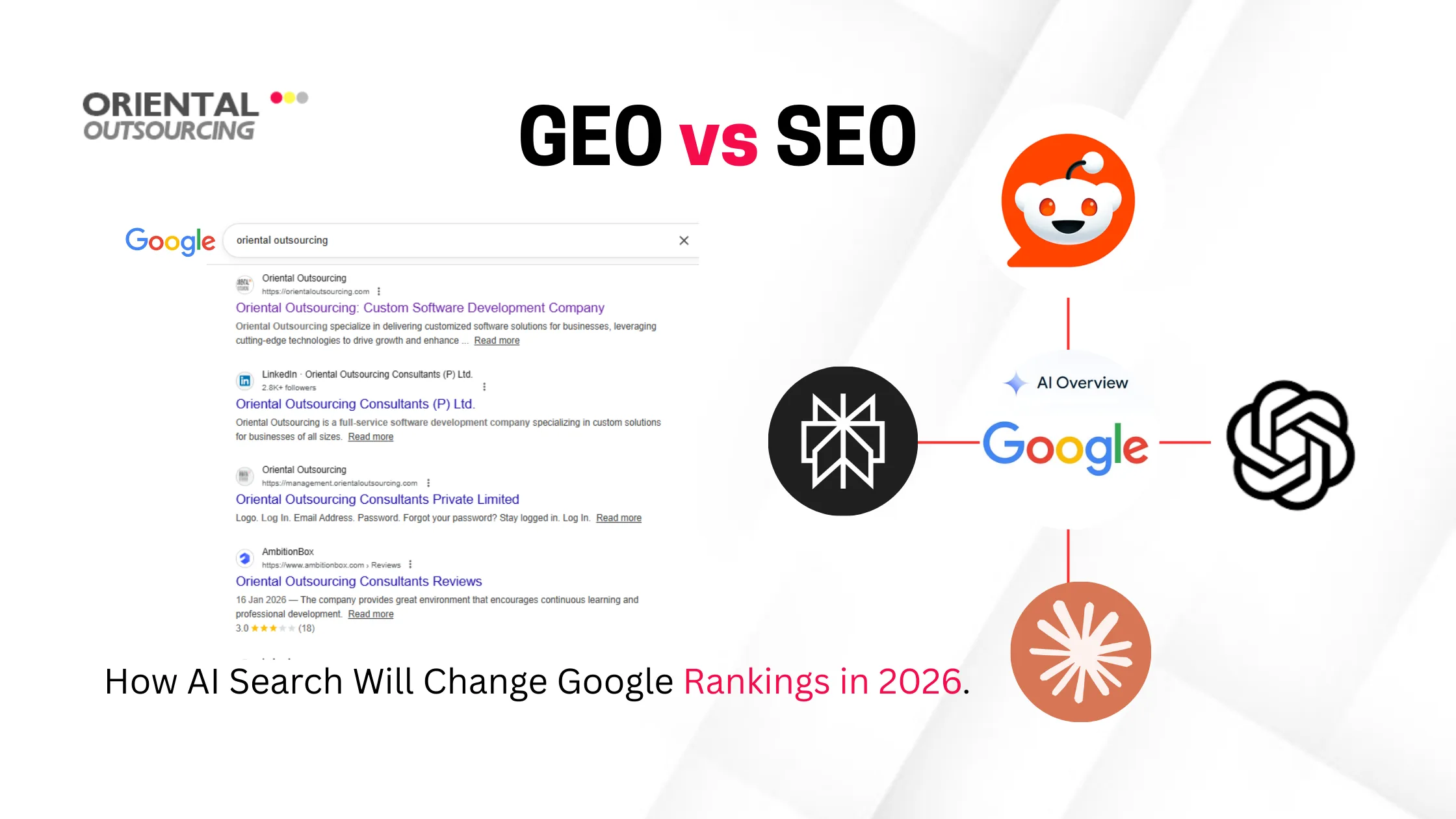
GEO vs SEO banner comparing traditional Google search rankings with AI-powered search and generative engine optimization in 2026.

GEO vs SEO: How AI Search Will Change Google Rankings in 2026

The battle between GEO vs SEO is reshaping digital marketing in 2026. If you’ve been doing SEO the same way for years, you’ve probably noticed something different lately. Your rankings might be stable, but traffic is dropping. Your content is good, but fewer people are clicking through. This isn’t random—it’s the shift from traditional SEO to GEO (Generative Engine Optimization) as AI reshapes how search works.

Google now shows AI Overviews for millions of queries. ChatGPT answers questions that people used to Google. Perplexity and Gemini are becoming research tools for buyers and decision-makers. At Oriental Outsourcing, we’ve seen this shift across dozens of client accounts. The pattern is clear: understanding GEO vs SEO isn’t optional anymore—it’s essential for survival.

TL;DR

  • SEO still builds the foundation for online visibility
  • GEO focuses on being cited in AI-generated answers
  • AI Overviews and chatbots are changing who gets seen
  • The GEO vs SEO debate isn’t about choosing one—you need both
  • The change is happening now, not someday

What Is SEO in 2026?

What is SEO in 2026 – visual explaining search engine optimization and how websites improve visibility in Google search results.

SEO hasn’t died. It’s evolved into something more fundamental.

Think of modern SEO strategy as building the foundation of your online presence. It’s making sure Google can find your pages, trust your site, and understand what you’re about. Good technical setup, quality content, and real expertise still matter—maybe more than ever.

But here’s what’s different: SEO used to be about getting to position one or two for your target keywords. That was the finish line. Now it’s just the starting point. Even pages ranking in the top three are getting less traffic because AI is answering questions before people ever click a link.

SEO in 2026 is your credibility layer. It proves you’re legitimate. It shows Google you know your topic. It builds the authority that makes everything else possible. Without it, nothing works. But by itself, it’s no longer enough.

What Is Generative Engine Optimization (GEO)?

Generative Engine Optimization (GEO) is about being the source AI systems quote when they answer questions.

Here’s how it works: When someone asks ChatGPT or Google’s AI a question, these systems don’t just show links. They create answers by pulling information from multiple sources, combining it, and presenting it as one coherent response. They’re not ranking websites—they’re extracting knowledge.

This changes everything about how content gets discovered.

AI doesn’t care if you rank number two for “project management software.” It cares whether your content has clear, trustworthy information it can use to build an answer. When you’re cited in that AI-generated response, thousands of people see your brand name even if they never click through to your site.

That’s GEO. It’s optimizing so AI systems trust you enough to reference you. It’s becoming the authoritative source that machines feel confident quoting.

GEO vs SEO: The Key Differences You Need to Know

Understanding GEO vs SEO means recognizing that these aren’t competing strategies—they’re complementary layers of modern search optimization.

Main Goal

Rank high in search results

Get cited in AI answers

How You Win

Be in top 10 positions

Be the trusted source

What You Optimize For

Keywords and search intent

Clarity and accuracy

Traffic Comes From

People clicking your link

People seeing you referenced

Success Looks Like

Position 1-3 ranking

Your brand mentioned in answers

Content Style

Search-optimized pages

Clear, quotable explanations

Brand Impact

Clicks lead to awareness

Authority built through citation

The biggest difference in the GEO vs SEO comparison? SEO gets you found. GEO gets you trusted before anyone even visits your website.

How AI Search Is Changing Google Rankings

The most important change isn’t happening to your rankings. It’s happening above them.

Google’s AI Overviews now appear at the top of search results for a huge number of queries. They answer questions directly, pulling information from multiple sources and synthesizing it into one response. Users get what they need without scrolling down to the traditional blue links.

This creates what’s called a “zero-click search.” The person gets their answer. Google keeps them on the page. Your well-ranking article sits below, unclicked.

We’ve tracked this across client sites. Pages that ranked position two or three and drove steady traffic are now getting 30-40% fewer clicks—not because they dropped in rankings, but because AI Overviews satisfied the query first. This is the new reality of organic visibility challenges in 2026.

But here’s the opportunity: when your content gets cited in those AI Overviews, your brand appears at the very top of search results. You get visibility without needing the click. Your name becomes associated with expertise on that topic.

Brand mentions in AI answers are becoming as valuable as backlinks used to be. Maybe more valuable, because they reach people at the exact moment they’re looking for answers.

The ranking factors you know—domain authority, quality content, technical SEO—still matter. But now they qualify you for citation rather than being the end goal themselves.

What Will Matter More Than Traditional SEO Signals

Google judges content quality using EEAT: Experience, Expertise, Authoritativeness, and Trustworthiness. AI systems are applying similar standards, but faster and more consistently.

Here’s what AI looks for:

Real expertise, not just keywords. AI can cross-reference what you say against thousands of other sources instantly. If you’re making claims that contradict established facts, AI notices. If your information aligns with authoritative sources and adds genuine insight, AI trusts it.

Consistent brand presence. AI builds connections between your brand, your topics, and your credibility. When your company appears across multiple authoritative contexts saying consistent things, AI develops confidence in citing you. Oriental Outsourcing has built this by creating connected content around digital growth—not random blog posts, but a complete knowledge system on related topics.

Clear structure and data. Schema markup and structured data help AI understand what your content represents. FAQ schema, article structure, and organization markup make it easier for AI to extract and use your information correctly.

Verifiable accuracy. Traditional SEO often optimized for engagement—clicks, time on page, shares. GEO requires content so factually solid that AI won’t hesitate to quote it. One wrong statistic can disqualify your entire article.

The shift is from “create engaging content” to “create content so accurate that machines trust it.”

How to Optimize Content for GEO

Writing for AI citation requires different habits than writing for human readers alone.

Write in clear, direct statements. Compare these two sentences:

  • “Our solution can potentially help improve your team’s productivity”
  • “The system reduces task completion time by 40% through automated workflows”

The second one is quotable. The first is marketing speak that AI ignores.

Keep your language consistent. If you introduce a term like “customer lifetime value,” don’t switch to “CLV” or “total customer value” later in the article. AI looks for consistent terminology to verify you’re talking about the same concept reliably.

Define terms clearly. When you explain something specialized, make it obvious. Use formatting to signal “this is the definition.” AI systems extract these explanations and reuse them.

Back up claims with specifics. “AI Overviews appear in 40% of searches” is citable. “AI Overviews are everywhere now” isn’t. Specific data points signal reliability to AI.

Avoid contradictions. If your introduction suggests one approach and your conclusion suggests the opposite, you’ve created confusion. AI cross-checks claims within articles. Inconsistency destroys trust.

Build topic clusters. AI favors brands with comprehensive coverage, not one-off articles. When you create connected content—pillar pages linking to detailed guides—you build the kind of depth AI recognizes as authoritative.

This is why thinking about content as part of a larger system matters. Individual great articles help. A complete knowledge ecosystem on your core topics wins.

GEO vs SEO: Should You Focus on One or Both?

The GEO vs SEO question creates a false choice. You need both, and here’s why.

SEO builds your credibility. It creates the technical foundation, establishes your expertise, and signals to Google that you’re legitimate. Without solid SEO, you won’t be considered for AI citation in the first place.

GEO turns that credibility into visibility in AI-powered answers. It ensures your hard-earned authority actually reaches people through the channels they’re increasingly using—AI Overviews, ChatGPT, voice assistants.

Here’s the sequence that works:

First, fix your SEO fundamentals. Make sure your site is technically sound, your content demonstrates real expertise, and you’re building authority in your topic area. Get this foundation right.

Then layer GEO optimization on top. Take that good content and refine it for AI citability. Make it clearer, more accurate, better structured. Remove contradictions. Add specific data. Use consistent language.

Think of it this way: SEO gets you in the game. GEO helps you win it.

Who Should Start GEO Today

Some businesses benefit from GEO more than others, at least right now.

SaaS companies should prioritize this immediately. Software buyers research extensively before purchasing. They ask AI assistants to compare features, explain use cases, and evaluate options. When ChatGPT cites your product as the solution for a specific problem, you’re influencing decisions before any sales conversation starts.

Digital agencies and consultants need GEO because potential clients use AI to research approaches and methodologies. When you’re referenced as the authority on a framework or strategy, you build credibility at scale.

eCommerce businesses with complex products benefit significantly. When customers ask “how to choose” or “what to look for,” being cited in AI answers positions you as the trusted guide—even if they don’t visit your site immediately.

B2B service companies with long sales cycles should invest now. Enterprise buyers do months of research before contacting vendors. Being consistently mentioned across AI platforms as a thought leader builds familiarity and trust long before outreach begins.

If your customers research before buying, if your sales cycle involves education, if you compete on expertise rather than price—GEO matters for you.

The Future of Search Beyond Rankings

This transition isn’t sudden. It’s gradual, but it’s already happening.

Rankings aren’t obsolete, but they’re no longer the complete picture of search success. Visibility now fragments across AI Overviews, chatbot citations, voice assistant responses, and traditional organic results. You need to show up across all these channels.

The good news? AI rewards the same qualities that always mattered: real expertise, clear communication, and factual accuracy. The difference is that AI can evaluate these at massive scale and speed.

There’s no shortcut here. No trick or hack. Just demonstrating genuine knowledge in ways AI can verify and confidently reference.

Brands that adapt early will build momentum. Every AI citation strengthens your entity recognition. Every mention reinforces trust signals. This compounds over time in ways that become hard for competitors to catch.

The opportunity is clearer than it’s ever been: help people understand topics genuinely, write with clarity instead of cleverness, back up what you say with evidence, and stay consistent across everything you publish.

In AI-driven search, visibility belongs to brands that teach, not those that chase algorithms.

If you’re ready to evaluate your AI search readiness and build a strategy that works for both traditional SEO and emerging AI platforms, the foundation you build now will serve you for years.

Frequently Asked Questions

What is the difference between GEO and SEO?

SEO optimizes content to rank in traditional search results using keywords and backlinks. GEO optimizes content to be cited in AI-generated answers from ChatGPT and Google’s AI Overviews. SEO aims for clicks; GEO aims for citations.

No. GEO builds on top of SEO. You still need strong technical SEO and quality content. GEO adds clarity and structure so AI can confidently quote you. SEO is your foundation; GEO is your AI visibility layer.

AI Overviews prioritize expertise, accuracy, and trustworthiness. They cross-reference claims and favor clear statements over marketing language. Brands with proven topic depth and verifiable information get cited more often.

Yes. GEO rewards expertise over budget size. Small businesses with helpful, accurate content can be cited alongside major competitors, building awareness and credibility that traditional advertising can’t match.