Realistic modern eCommerce workspace showing organic traffic growth versus paid ads on a laptop, professional corporate setup

Is SEO Worth It for eCommerce Businesses in 2026? Cost, ROI & Real Results

You’re sitting on a product catalog that could generate six or seven figures. But your organic traffic is stuck at zero, and Google Ads are bleeding your margins dry.

So the question keeps coming back: is SEO worth it for eCommerce businesses like yours?

Here’s the truth most agencies won’t tell you upfront. SEO isn’t a quick win. It takes months before you see meaningful results. But once it kicks in, it compounds. Paid ads stop working the moment you stop paying. SEO keeps delivering traffic and sales long after the work is done.

This article breaks down the real eCommerce SEO cost, expected eCommerce SEO ROI, and whether it makes sense for your store in 2026.

Is SEO Worth It for eCommerce Businesses in 2026?

Yes, but only if you’re willing to treat it like a long-term investment.

SEO works best for eCommerce stores that want sustainable growth without being held hostage by rising ad costs. If your product margins are thin and your customer lifetime value is decent, SEO becomes one of the most profitable channels you can build.

The eCommerce SEO benefits are clear:

  • You own the traffic. No algorithm changes or rising CPCs can take it away overnight.
  • Compound returns. Traffic grows month over month without proportional increases in cost.
  • Higher trust. Organic listings convert better than ads because buyers trust Google’s recommendations.
  • Lower acquisition costs. Once you rank, your cost per acquisition drops significantly.

But here’s the catch. SEO requires patience, consistent execution, and realistic expectations. If you need sales tomorrow, SEO won’t save you. If you want predictable revenue in six to twelve months, it’s one of the smartest moves you can make.

Why Paid Ads Alone Fail for eCommerce

High-quality eCommerce desk showing paid ads dashboard with rising costs and flat revenue, realistic office setting

Paid ads work. No question. But relying only on Google Ads or Facebook Ads is like renting a storefront instead of owning property.

Your margins shrink every year. CPCs have been climbing for years. What cost you two dollars per click in 2022 might cost you four or five dollars today. As competition increases, your profit per sale decreases.

You’re invisible when ads stop. Turn off the budget, and traffic goes to zero. No safety net. No residual sales.

Customers don’t trust ads as much. Studies show that organic search results get more clicks and higher conversion rates than paid placements. People skip ads and scroll down to the “real” results.

The smartest eCommerce businesses don’t pick between SEO vs paid ads eCommerce. They use both. Ads fund short-term growth. SEO builds long-term equity.

How SEO Compounds Revenue Over Time

This is where SEO separates itself from every other marketing channel.

Let’s say you invest in SEO starting today. For the first three months, you see minimal results. Maybe a few rankings improve. Traffic ticks up slightly.

Then month four hits. A handful of product pages start ranking on page one. Traffic doubles. Sales start coming in from keywords you didn’t even target directly.

By month eight, those rankings solidify. You add more optimized content. Now you’re ranking for dozens of high-intent keywords. Traffic has tripled or quadrupled from where you started.

Here’s the magic part. You didn’t triple your SEO budget. You’re still doing roughly the same amount of work, but the results keep stacking. That’s compounding.

Compare that to paid ads. If you want to triple your ad traffic, you need to triple your ad spend. Every month. Forever.

SEO is the only channel where your cost per acquisition goes down over time while traffic and revenue go up.

If your store isn’t ranking and you’re not sure why, this guide on why your eCommerce store isn’t ranking on Google covers the most common technical and content issues holding stores back.

eCommerce SEO Cost in 2026 (Real Numbers)

Let’s talk money. What does eCommerce SEO cost if you want real results?

DIY SEO: Free to a few hundred dollars per month for tools. But you’re trading money for time. Expect to spend 10 to 20 hours per week learning and optimizing.

Freelancer SEO: Anywhere from $500 to $2,500 per month depending on experience. You’ll get basic optimizations, some content, and maybe technical fixes. Quality varies wildly.

Agency SEO: Most reputable eCommerce SEO agencies charge between $2,000 and $10,000 per month. The range depends on your catalog size, competition level, and growth goals.

For a mid-sized eCommerce store with 100 to 500 products, expect to invest at least $3,000 to $5,000 per month for six to twelve months to see meaningful results.

That might sound like a lot. But compare it to your monthly ad spend. Most eCommerce stores spend that much or more on ads every single month. The difference? SEO keeps working long after you stop paying.

eCommerce SEO ROI vs Paid Ads

Let’s run the numbers.

Say you spend $5,000 per month on SEO for twelve months. Total investment: $60,000.

By month six, you start seeing 5,000 organic visitors per month. By month twelve, that grows to 15,000. If your conversion rate is two percent and your average order value is $100, that’s 300 orders per month or $30,000 in monthly revenue from organic traffic alone.

Now you’re generating $360,000 per year from a $60,000 investment. That’s a six-to-one return, and it keeps growing.

Compare that to paid ads. Spend $5,000 per month on Google Ads, and you might generate $15,000 to $25,000 in revenue depending on your margins. Stop spending, and revenue stops.

The eCommerce SEO ROI advantage is undeniable once you hit critical mass. The first six months are tough. But after that, SEO often becomes your most profitable channel.

When SEO Does NOT Make Sense for eCommerce

SEO isn’t always the right answer. Here’s when you should skip it or delay it.

You need sales this week. SEO takes months. If you’re running out of cash and need revenue immediately, paid ads and email marketing are faster.

Your product is highly seasonal. If you only sell Christmas decorations, building year-round SEO might not deliver the ROI you need. Paid ads during peak season make more sense.

You’re in a hyper-competitive niche with zero budget. Competing against Amazon and major retailers in broad categories requires serious budget and patience.

Your site is a mess. If your eCommerce platform is slow, mobile-unfriendly, or full of technical errors, SEO won’t work until you fix the foundation.

You’re not committed for at least six months. SEO requires consistency. If you’re going to quit after two months, save your money.

How Agencies Measure eCommerce SEO Success

Good agencies don’t measure SEO success by rankings alone. They track metrics that actually matter to your bottom line.

Organic traffic growth. How many visitors are you getting from Google each month? Is it trending up consistently?

Revenue from organic search. What percentage of your total revenue comes from organic traffic? Is it increasing quarter over quarter?

Keyword rankings for high-intent terms. Product keywords, category keywords, and commercial terms that drive sales.

Cost per acquisition from SEO. Divide your total SEO investment by the number of customers acquired through organic search. Compare this to your CPA from paid ads.

SEO vs Paid Ads: The Smart Strategy in 2026

Good agencies don’t measure SEO success by rankings alone. They track metrics that actually matter to your bottom line.

Organic traffic growth. How many visitors are you getting from Google each month? Is it trending up consistently?

Revenue from organic search. What percentage of your total revenue comes from organic traffic? Is it increasing quarter over quarter?

Keyword rankings for high-intent terms. Product keywords, category keywords, and commercial terms that drive sales.

Cost per acquisition from SEO. Divide your total SEO investment by the number of customers acquired through organic search. Compare this to your CPA from paid ads.

Final Verdict

So, is SEO worth it for eCommerce in 2026?

Absolutely. If you’re willing to invest six to twelve months and treat it like building an asset, not a quick fix.

SEO delivers compounding returns, lowers your cost per acquisition, and gives you traffic you own. Paid ads deliver speed and control but require constant spend. The best strategy uses both.

If you want predictable growth instead of temporary traffic spikes, eCommerce SEO delivers compounding returns.

Need help building a sustainable SEO strategy for your store?

We’ve helped dozens of eCommerce brands break free from the paid ads treadmill and build profitable organic channels. If you’re ready to invest in long-term growth, get in touch with us here or email us.

FAQs

Is SEO still worth it for eCommerce in 2026?

Yes, SEO is still worth it for eCommerce in 2026 as paid ad costs continue to rise. Organic search remains one of the highest-converting channels because buyers trust Google’s rankings more than ads. SEO now requires strong technical setup, quality content, and authority, but once rankings are achieved, traffic and sales compound without increasing costs.

Most eCommerce stores start seeing results within four to six months. The first three months focus on technical fixes and optimization. Traffic and sales usually begin growing around month four, with strong momentum building by month twelve.

eCommerce SEO typically delivers a four-to-one to ten-to-one ROI within twelve months. ROI improves over time because traffic continues growing while monthly SEO costs remain relatively stable.

SEO and paid ads serve different goals. Paid ads provide immediate traffic and fast sales, while SEO builds long-term organic traffic that compounds over time. The most successful eCommerce brands use both together.

For mid-sized eCommerce stores with 100–500 products, a monthly SEO budget of $3,000 to $5,000 for six to twelve months is realistic. Smaller budgets can work, but results will be slower. A good rule is to allocate a portion of your ad spend toward SEO for long-term growth.
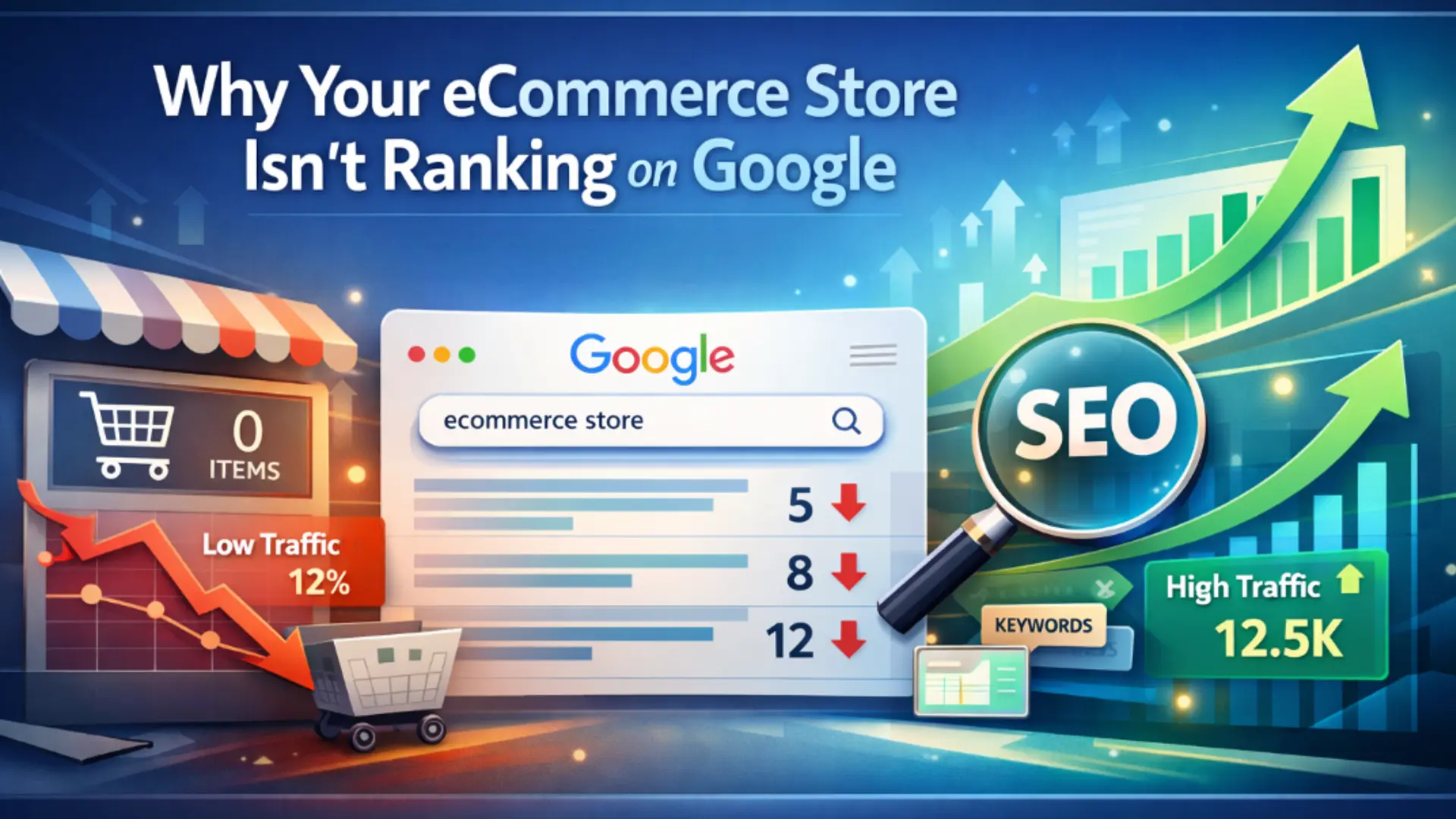
Why Your eCommerce Store Isn't Ranking on Google And How We Fix It

Why Your eCommerce Store Isn’t Ranking on Google And How We Fix It

You launched your store with real excitement. Your products are solid. Your ads bring visitors—until you turn them off and the traffic disappears. But when you search Google for what you sell? You’re nowhere. Your competitors show up. You don’t.

If your eCommerce store isn’t ranking on Google, you’re not alone. Thousands of online store owners face this exact problem every single day. You’ve probably asked yourself: “Why isn’t my online store visible in search results?” or “Is something fundamentally broken with my SEO?” Maybe you’ve even wondered if Google just doesn’t like eCommerce stores.

Here’s what we can tell you after 20+ years at Oriental Outsourcing auditing hundreds of eCommerce websites: it’s not Google’s fault, and it’s probably not your fault either. When an eCommerce store isn’t ranking on Google, it’s usually because of the same structural SEO problems that make ranking nearly impossible—no matter how good the products are.

This isn’t another generic SEO checklist. This is how we at Oriental Outsourcing actually diagnose why stores don’t rank, what’s stopping Google from finding and trusting your pages, and what it takes to fix it. If you’ve been stuck in paid-ads-only mode and wondering why organic traffic never shows up, this will help you understand exactly what’s going wrong.

The Real Reasons Your eCommerce Store Isn't Ranking on Google

Google doesn’t rank stores—it ranks individual pages. When an eCommerce site isn’t ranking, it’s because its pages don’t give Google a clear reason to show them.

Most stores are built to sell, not to rank. Product pages are thin or repetitive, category pages lack real content, and filters create thousands of unnecessary URLs. Everything looks fine to users, but to Google, the structure is confusing.

This is what we see in nearly every audit at Oriental Outsourcing. Store owners think they have many rankable pages, but most are too weak or poorly structured to perform.

The site works for paid traffic—but it isn’t built for organic search. That’s the core reason many eCommerce stores don’t get Google traffic.

Common SEO Mistakes Killing eCommerce Rankings

Let’s talk about the specific mistakes that show up again and again in our audits. These aren’t small issues. They’re the difference between ranking and being invisible.

Targeting the Wrong Keywords

Most stores optimize for the wrong search terms without realizing it. You’re ranking for your product SKU codes or brand-specific terms that nobody searches for. Meanwhile, the actual keywords your customers use—the category-level terms, the problem-solution phrases, the buying intent queries—those go to your competitors.

If you sell “organic cotton baby blankets,” but your pages only mention your product name “CloudSoft Blanket Model CB-405,” you’re missing everyone searching for what you actually sell. This is a primary reason why many eCommerce stores struggle to rank on Google.

Duplicate Content Across Products

When you have 50 products in the same category, it’s tempting to reuse descriptions. Change the color, swap the size, copy the same features. Google sees this as 50 nearly identical pages competing against each other. Or worse, you’re using the manufacturer’s description—the exact same text that’s on 100 other websites selling the same product.

No Clear SEO Structure

Your URLs look random. Products aren’t connected to their categories in any meaningful way. There’s no internal linking strategy, so Google can’t understand what’s important on your site or how your pages relate to each other. Everything’s just floating independently, fighting for attention.

Relying Only on Paid Ads

Here’s the truth about ads: they work until you stop paying. Ads bring traffic, but they don’t build authority. They don’t teach Google what you sell or why your site deserves to rank. When your ad budget runs out or gets too expensive, you’re back to zero traffic. SEO builds a foundation that keeps working whether you’re spending money or not.

Why Product Pages Don't Rank (Even If Your Products Are Great)

Many store owners ask, “My products are better—so why don’t my pages rank?”
Because Google doesn’t rank products. It ranks helpful pages.

Searchers want answers, comparisons, and context—not just a short description and an “Add to Cart” button. Most product pages are thin, lack FAQs, trust signals, and internal links, and don’t clearly explain who the product is for or why it’s better than alternatives.

As a result, Google doesn’t see these pages as important.

At Oriental Outsourcing, we enhance product pages with the content and structure needed to match real search intent—turning thin pages into pages that deserve to rank.

Category Pages – The #1 Missed SEO Opportunity in eCommerce

If there’s one SEO tip that can transform your results, it’s this: optimize your category pages.

Most stores treat them as simple product grids, but well-optimized category pages drive 60–70% of organic revenue. Google loves them because they match search intent—shoppers want options and context, not a single product.

To rank, category pages need real content: intros, buying guides, FAQs, and helpful context. Internal linking from the homepage, related categories, and blogs signals importance to Google.

Also, watch out for filter URLs—they create crawl issues. Done right, your category pages become SEO powerhouses without breaking your site.

The Local SEO Factor Most eCommerce Stores Ignore

Many eCommerce store owners overlook local SEO, but it can be a powerful growth lever. If you serve specific regions, offer local pickup, or same-day delivery, local optimization helps you appear in location-based searches.

Local SEO improves visibility through Google Business Profiles, local citations, and location-focused content—driving highly qualified, ready-to-buy traffic.

At Oriental Outsourcing, we help eCommerce brands use local SEO alongside broader SEO strategies to gain an edge over competitors focused only on national keywords.

Technical SEO Issues We Consistently Find in eCommerce Audits

Many eCommerce ranking problems are invisible but critical to Google. Issues like index bloat, faceted navigation, slow page speed, mobile inconsistencies, and JavaScript rendering often prevent stores from ranking—without owners realizing it.

Google wastes crawl budget on unnecessary URLs, struggles to understand your content, and sees poor user experience signals. The result? Weak or no rankings.

At Oriental Outsourcing, we audit and fix these technical issues first because they form the foundation of every successful eCommerce SEO strategy.

How Oriental Outsourcing Fixes These Problems

When we take on an eCommerce store with low organic visibility, we start with a real SEO audit—not an automated score. Our team reviews site structure, analyzes how Google sees your store, and identifies the exact issues blocking rankings.

Next is keyword mapping. Each page has a clear role: product pages target product terms, category pages target broader keywords, and blogs support informational searches—no overlap, no confusion.

Then we optimize content and internal linking to match search intent, improve thin pages, and clearly signal what matters most to Google.

We also handle technical cleanup, fixing crawl issues, index bloat, speed, and mobile problems—often the fastest wins.

Finally, we focus on ongoing optimization. SEO isn’t one-time work. We monitor performance, adapt to changes, and provide clear reporting so you always know what’s driving results.

When You Should Consider Hiring an eCommerce SEO Agency

SEO agencies aren’t for every store. If you just launched, you might not need help yet. But if your store has been live 6–12 months, organic traffic is near zero, ads are costly, multiple categories aren’t ranking, or you’re in a competitive or international market, professional eCommerce SEO is worth it.

Unlike ads, SEO builds lasting results—today’s work keeps driving traffic months from now, creating a true asset instead of rented traffic.

Partner with Oriental Outsourcing for Results-Driven eCommerce SEO

Most eCommerce stores don’t rank on Google because they weren’t built with SEO in mind. The issues usually stem from site structure, technical errors, and content that doesn’t match real search intent—but they are fixable.

At Oriental Outsourcing, we help eCommerce brands identify and resolve these root problems, turning low visibility into consistent, profitable organic traffic.

If your store isn’t ranking, a professional eCommerce SEO audit is the first step. We show exactly what’s holding your site back and what to fix first—no guesswork.

Ready to reduce ad dependency and grow sustainable organic traffic? Contact us today and see why eCommerce businesses trust Oriental Outsourcing.

Frequently Asked Questions About eCommerce SEO

1. How long does it take for an eCommerce store to rank on Google?

Most eCommerce stores see early improvements in 3–4 months, while strong rankings usually take 6–12 months. The timeline depends on competition, technical SEO issues, and site size. Quick gains often come from fixing technical problems, but long-term traffic growth requires ongoing optimization. SEO takes time—but once rankings improve, traffic continues without paying for every click.

You can manage basic SEO if your store is small and new. However, most established eCommerce stores struggle due to technical and structural SEO issues that aren’t easy to spot. If you’ve tried SEO for months with little progress or rely heavily on ads, working with an experienced SEO agency usually delivers better and faster results.

Google doesn’t rank based on product quality—it ranks pages based on search intent and optimization. Competitors often win because their pages are better structured, target the right keywords, load faster, and provide clearer information. Strong products need strong SEO to compete.

Yes. Ads stop the moment you stop paying, while SEO builds long-term, compounding traffic. Many eCommerce stores use ads for short-term results and SEO for sustainable growth. Over time, SEO can reduce ad dependency and improve overall profitability.

The biggest mistake is ignoring category page SEO. Category pages match buyer search intent better than individual products, yet many stores don’t optimize them. Well-optimized category pages often drive the majority of organic revenue and deliver the fastest SEO returns.